EVENTS · JUNE 23, 2026
AI House, and the case for smaller rooms
Field notes from a curated, house-format AI gathering in Otopeni. The argument: in AI right now, information is cheap and honest conversation is expensive, and a room of fifty builders is the fastest way to buy it.
David Marin · 6 min read
Contents
The most useful thing at AI House was not on the schedule. It was twenty minutes by the pool, where a founder walked me through exactly what was breaking in their product. No badge, no booth, no pitch. Just the real version of the problem, said out loud, because the setting made that the natural thing to do.
Days later, that is the part I keep returning to. We judge events by their speakers and their agendas. We almost never judge them by the room. AI House, held in a private house in Otopeni on 19 and 20 June, was built around the room first: around fifty people from AI startups, technology companies, investment firms, and research groups, two days, one house with a kitchen and a pool. These are my field notes.
How the two days were shaped
Fri evening
Arrivals, no agenda
Dinner and the pool. The first real conversations happened before anything was formally scheduled.
Sat morning
Workshops
Practical sessions on adoption and scaling. Useful, though the corridors between them were often better.
Sat afternoon
Builder hot seats
Founders put a real problem on the table and the room pushed back. The highest-signal hour of the weekend.
Sat evening
Loose ends
Smaller groups, slower talk, the late-night follow-ups that turn a contact into a collaborator.
Information is cheap. Conversation is expensive.
Here is what I came away believing. In AI right now, information is not the constraint. Everyone has the same model access, reads the same launch posts, and sees the same demos within a day of each other. What is scarce, and getting scarcer, is honest conversation with people who are actually shipping.
A room like this manufactures exactly that. Two days of direct, unguarded talk with fifty builders compressed weeks of calibration into a weekend. Not because anyone delivered a grand thesis, but because you could ask the dumb question, get the real answer, and check it against three other people by dinner.
What a house does to a conversation
A house is not a neutral container. It changes what people are willing to say.
At a conference you stand, hold a coffee, and keep half an eye on the room for the next person you are meant to meet. The conversations are built for exit. In a house you sit down, you eat together, and you keep ending up in the same three rooms. A shallow conversation costs more there, because you will see that person again in an hour.
It felt closer to a builder retreat than an event, and I mean that as a plain description, not a flourish. The relaxed setting lowered the guard people keep up in professional rooms. When you are not performing for an audience, you get to the true thing faster. You admit what is not working. You ask the question you would never ask from a stage.
The organizers, Andrei Ilie and Alex Gavril at Promocrat, clearly designed for exactly this. The published agenda gave the two days a spine: workshops, discussions, and builder hot seats. But the spine was there to hold up the unstructured hours, which is where the value lived.
The contrast with a normal conference is sharpest laid side by side. Same two days, roughly fifty people, and almost everything about how the time gets spent moves:
| Big conference | The house | |
|---|---|---|
| Who is in the room | Anyone with a ticket. | ~50 people, each one selected, each building something. |
| How you stand | Upright, coffee in hand, scanning for the next handshake. | Sat down, eating together, finishing the thought. |
| What gets said | The polished version, for the audience. | The real version, because nobody is performing. |
| Follow-up | A stack of cards you never email. | People you will see at lunch, so you actually do. |
Big conference
- Who is in the room
- Anyone with a ticket.
- How you stand
- Upright, coffee in hand, scanning for the next handshake.
- What gets said
- The polished version, for the audience.
- Follow-up
- A stack of cards you never email.
The house
- Who is in the room
- ~50 people, each one selected, each building something.
- How you stand
- Sat down, eating together, finishing the thought.
- What gets said
- The real version, because nobody is performing.
- Follow-up
- People you will see at lunch, so you actually do.
Two ways to spend the same two days.
What I actually heard about the state of AI
If you want a read on where AI is, do not read the launch posts. Listen to what builders have quietly stopped saying, and what they keep returning to.
Three things came up again and again. Distribution is the real bottleneck, not capability: plenty of teams have a good model and no clean path to users. Reliability is where the serious work moved, and the interesting teams now talk about evals the way they used to talk about features. And the energy has shifted from what a model can do to whether it will do the same thing twice.
None of that is in a changelog. It is the kind of read you only get from people willing to tell you what is not working, which is the entire point of a room like this.
The most useful thing I took home: outbound
The single most practical takeaway was about outbound, and it caught me off guard.
The short version: AI did not kill cold outreach, it made it work again. The cost of genuinely researched, personalized outbound has dropped close to zero, which means the channel most small teams had written off is suddenly the cheapest distribution they have. Instantly.ai, the main sponsor, kept coming up as the all-in-one platform people actually run this on: list, sequence, send, and measure in one place. Not a logo on a wall; something builders were using in earnest.
Here is the shape of it, as I kept hearing it described:
Outbound, the way I kept hearing it
- 01Tight listFifty right accounts beat five thousand random ones.
- 02Research with AIUse the model to find the real, specific reason to reach out.
- 03Write like a humanShort, specific, one ask. The AI does the homework, not the talking.
- 04Run it on railsA tool like Instantly.ai to sequence, send, and measure.
I went in skeptical of outbound. I am leaving with a small, specific experiment to run for Sussur: a tight list, AI-researched, and one human email each.
What I'm changing about Sussur
I build Sussur, an AI agent that helps you know what to say next and remembers what matters from your conversations. I went in planning to listen more than I talked, and the most useful feedback was the kind I did not ask for.
The clearest signal was about positioning. I have been describing Sussur by what it does. The people who understood it fastest did not care about the feature list; they cared about what it removes: the quiet dread of walking into a high-stakes conversation underprepared, and the memory tax of tracking what matters across dozens of relationships. A weekend of back-to-back conversations was, conveniently, the exact situation Sussur is built for.
So I am changing two things. I am leading with the pain, not the feature list. And I have cut the parts of the roadmap nobody mentioned once, a conversation-analytics dashboard among them, to put that time into the one thing everybody leaned in on. You can see where it is headed at sussur.ai.
There was a quieter prompt about Sussur too, and it came from a sponsor. Sussur already does text-to-speech and speech-to-text, so a conversation can happen out loud, not only on a screen. Seeing ElevenLabs up close, another of the weekend's sponsors, put a ceiling in view: that voice layer can be far more natural, lower-latency, and less robotic than the version I shipped and then half-forgot. I came home treating voice as something to push on again, not a box already ticked.
What I'm taking home
I left with a shorter to-do list and a clearer story, which is the opposite of what two days of talking usually produces.
My real takeaway from AI House is less about AI than about format. The technology is moving fast enough that the bottleneck is not information; it is honest conversation with people doing the work. A house full of builders is an efficient way to get that, and I suspect we will see more events shaped like this one.
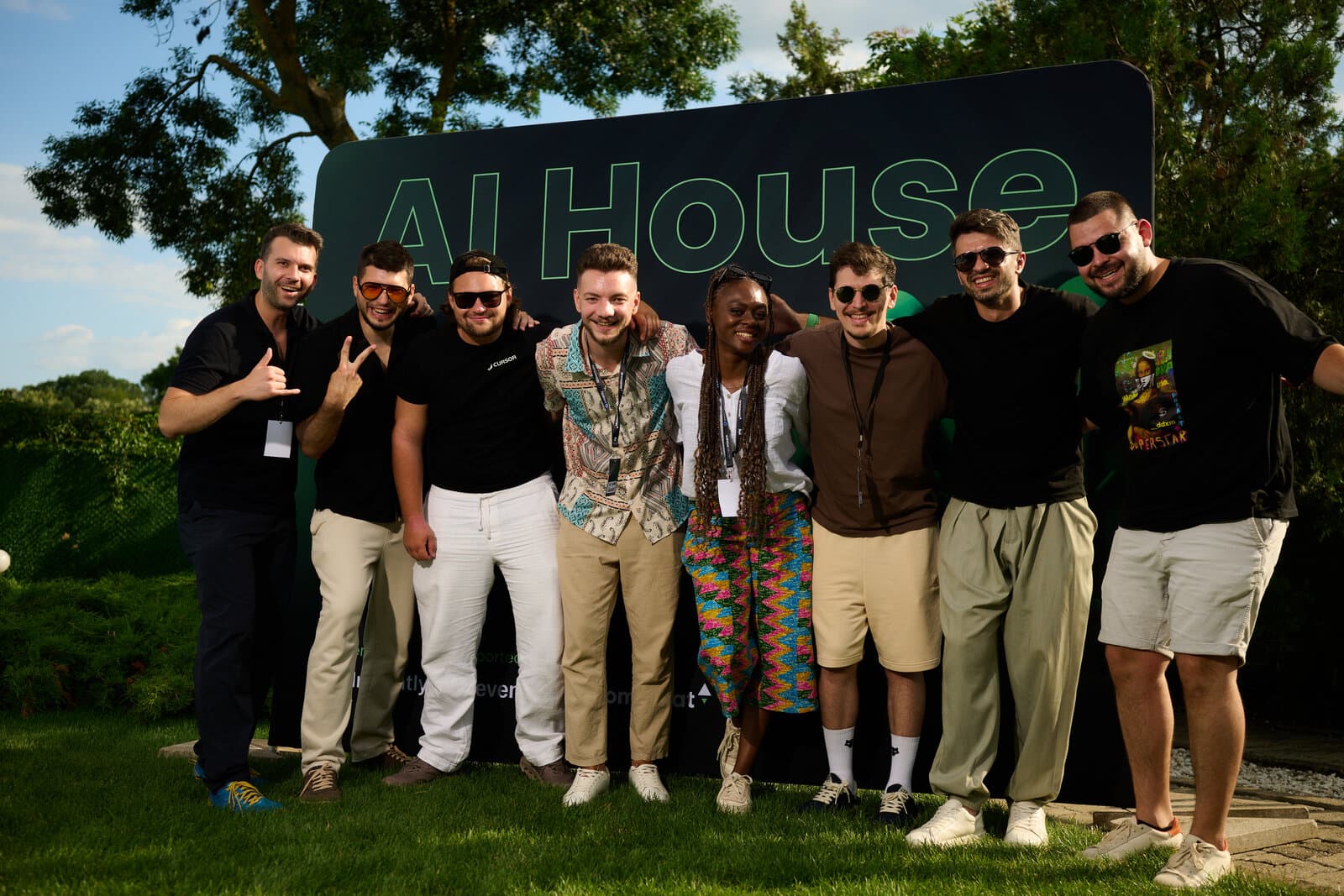
A few frames from the weekend. The room was the point:
In a photo and would rather not be? Email office@basetool.ai and we'll take it down.
Thank you to Andrei Ilie and Alex Gavril at Promocrat for the curation and the care it clearly took, to Instantly.ai, ElevenLabs, and Bolt for making the weekend possible, and to everyone who sat down and spoke plainly. I came to listen and left with more than I expected. If this becomes a regular thing, I will be glad to be in the room again.