EVENTS · JUNE 28, 2026
Five days at Delta Bootcamp: every lesson, and what I changed in Sussur
The full field notes from the first Delta Bootcamp by Launch Romania, mentor by mentor: Irina Scarlat, Andy Budd, Zoltan Vardy, Jason Meresman, Cosmin Curticapean and Marius Nedelcu, plus what I rebuilt in Sussur two weeks after.
David Marin · 10 min read
Contents
- The frame, before the sessions
- What each mentor drilled in
- Irina Scarlat — earn PMF before anything else
- Andy Budd — the PMF rollercoaster
- Zoltan Vardy — price like it's a differentiator
- Jason Meresman — judgment is the new moat
- Cosmin Curticapean — raising is harder than selling
- Gina Dragulin — pressure-test the problem
- Adriana — fix how you talk about the problem
- Marius Nedelcu — the go-to-market framework, end to end
- What I changed in Sussur, two weeks later
- The week in photos
- What I came home with
- Useful links
I went to Delta Bootcamp not knowing how much I would leave with. Five days later I drove home with a real network, a notebook I still open every morning, and a clear list of things to stop building. This is the honest, complete version: the format, every mentor session worth writing down, and what I actually changed once I was back at my desk.
Delta Bootcamp is the new five-day program from Launch Romania, the founder basecamp built by How to Web and powered by BCR. The pitch is plain: from Romania, for the world. The first edition put 50 technology founders in a room with roughly 30 investors, operators, and product and growth people, and ran us through product, sales, hiring, fundraising and international growth.
50
Founders in the room for the first edition, with roughly 30 investors, operators and product people across five days.
Delta Bootcamp, edition 1 — Launch Romania
How the five days were shaped
Days 1–2
The Bucharest hub
At a builders space in the city. Sharp talks, and strategy challenged in real time. This is where the framing happened.
Day 3
Off-grid
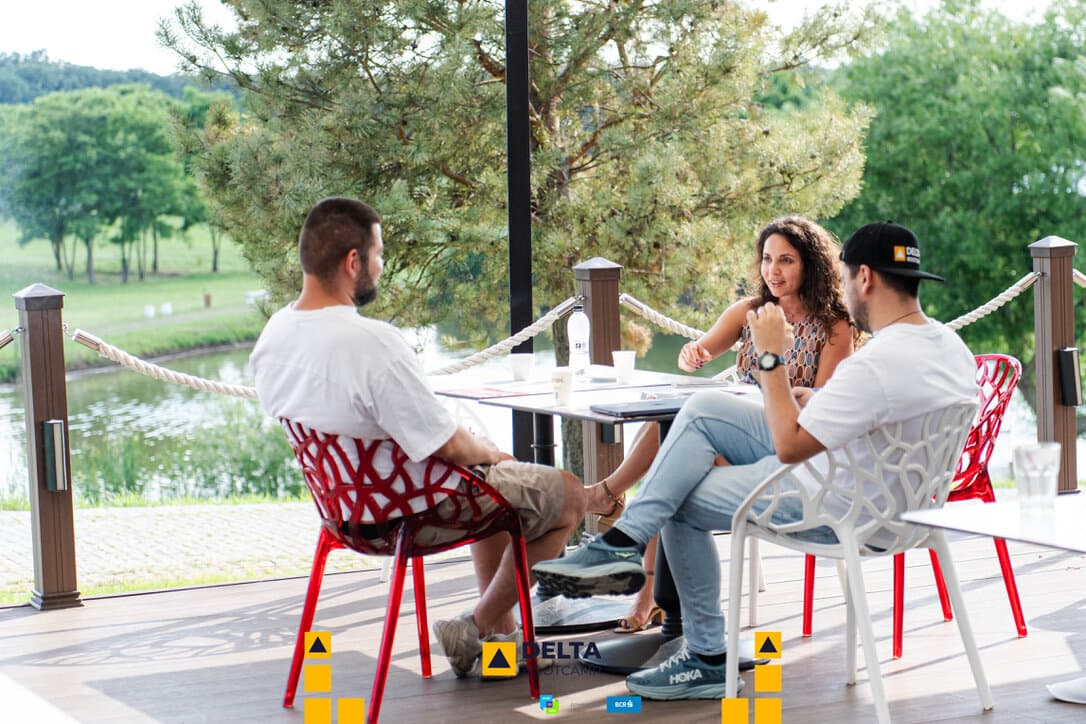
We left for Casa Vlăsia near Snagov. A quiet complex with a pool and a lot of green, built for deep work instead of performing.
Days 4–5
Clinics and 1:1s
Walking clinics on your real stuck point, not your pitch. One-on-ones with mentors who had built and sold real things.
Throughout
The networking night
Mentors, founders and investors in one room after hours. Half the value of the week lived here.
The frame, before the sessions
A few things got said on day one that colored everything after. Your advantage as an outsider is real: bring know-how from one domain into another and you see what the incumbents stopped noticing. Refuse the limitations people hand you. Find the champion, the person who actually feels the pain and can say yes, and figure out where you can meet them. And know that sales people are drowning in tools: they do the work, but most of them do not know how to do it well, which is the gap a good product fills. Look a little bigger than you are, confident and subtle, never small. Then let real traction, not vanity numbers, tell you whether any of it is working.
What each mentor drilled in
I filled pages. Here is the curated version, session by session, kept to the lines that survived the drive home. Swipe through the highlights first, then read the full breakdown below.
The mentors, in one swipe
Eight sessions, one idea each. Swipe, or use the arrows and dots.
01 / 08
Irina Scarlat — earn PMF before anything else
Irina's whole arc was about not getting ahead of yourself. Don't fall in love with the product; treat it as an iterative sequence, not a finished thing. Your first real hire is the person who owns go-to-market. Pick a beachhead narrower than your ICP and do things that don't scale to win it, the bowling-alley move from Crossing the Chasm. Build in public on LinkedIn and X, but only once you have PMF and some audience, never before. The signals that you're there: word of mouth, stickiness, engagement and paying customers, in that order. And the line that reframes everything about spend: trust lowers your CAC and raises your LTV, so the soft stuff is unit economics.
Ship a minimum lovable product, not a minimum viable one. When the experience is genuinely sleek, adoption is hard but churn is tiny, and word of mouth does the selling for you.
She was just as precise about referrals: they only work after a genuinely good experience, not at the first aha moment, and a two-weeks-trial-then-give-a-month-get-a-month structure beats bribing people early. Reading list from her session: Crossing the Chasm, Blitzscaling, and Andrew Chen's The Cold Start Problem on network effects.
Andy Budd — the PMF rollercoaster
Andy Budd personalised it with real examples and named the emotional shape of the search: denial, anger, blame, depression, acceptance. His warning was a number. It takes about three times longer to reach PMF than you think, and product-led growth or build-in-public only works once you actually have it plus some personal brand behind you. He pushed back hard on a common founder bias: don't discredit sales and marketing, they matter as much as product and engineering. You don't need a Swiss Army knife for an MVP, so remove blockers instead of adding features. Create urgency by answering "why is now the best time to buy?". Chase language-market fit, not just product-market fit. And on money: freemium works with moving barriers (think Granola, Wispr Flow), keep an eye on the CAC-to-LTV ratio (roughly 1:3 is healthy), and make the product demo itself instead of relying on you being good in the room.
The PMF rollercoaster, as Andy Budd named it
- 01Denial
- 02Anger
- 03Blame
- 04Depression
- 05Acceptance
3×
Andy Budd’s rule of thumb: reaching product-market fit takes roughly three times longer than you plan for.
Delta Bootcamp session, June 2026
Zoltan Vardy — price like it's a differentiator
Zoltan Vardy ran the go-to-market and pricing session, and his core move was to stop being timid about price. Price to the impact you create, by usage or by outcome where you can, and never land in the comfortable middle, too cheap and too expensive both read as a signal. Your competitive advantage has to be meaningful, deliverable and defendable, not just a nicer landing page. Say your value proposition like you'd say it to a five-year-old, in ten seconds. Keep the menu short, the restaurant-menu problem is real: three clean packages (small audit, standard analysis, tailored) beat a confusing buffet, and pay-as-you-go can beat tiers when the value is uneven. Then earn belief with credibility: logos, testimonials, awards. His homework was simple and brutal: tell your value prop to as many people as you can and watch whether they actually understand it.
Jason Meresman — judgment is the new moat
Jason's session was the one I keep coming back to.
AI makes it easy to build something nice that nobody uses. The bottleneck is no longer engineering, it's judgment about what not to build. AI slop becomes product slop.
The whole talk followed from that. One person now does the work of ten, so the scarce skill is product judgment, not building. Speak to customers every day and ask "what would prove me wrong?", because polishing the product is the comfortable way to avoid the answer. None of the usual trophies are PMF: not Product Hunt likes, not App Store ratings, not a waitlist, not even raising money, which is just fuel to fail faster. Measure retention in cohorts at the right resolution (daily, weekly, monthly) against the behaviour you actually expect. Ask users straight: "how much would you pay for this?", and run Sean Ellis's PMF survey. The new moats are building for agents (MCP-first, deep field expertise) rather than another interface. For B2B, the test is "who gets fired, or promoted, if this works?". And his framing for the whole AI wave stuck with me: gen-AI is electricity, the infrastructure layer, and the winners are the factories that already have demand and can now serve it faster and cheaper. Focus on the next milestone, not the exit: 1M ARR, then 10M, then 500M, each one will keep you busy. The buyer he kept pointing at, a VP of Sales or a CFO cutting cost through automation, is exactly mine.
Cosmin Curticapean — raising is harder than selling
Cosmin Curticapean was blunt about fundraising in a hard market. Angels are the smartest money because they have skin in the game; a VC plays with other people's. It is harder to find the right investor than the right customer, so align your idea to the investor's thesis and do your homework on them exactly like you would on a big B2B account. Fundraising is a process, not an event: be present in the market where you want to raise, and have something like 40 to 50 percent of your traction coming from that market before you go ask for money there. Raise after your stage, not before it, to keep equity with the founders. A good angel often becomes your advisor, so target syndicates and business angels strategically rather than spraying decks.
Gina Dragulin — pressure-test the problem
Gina's session was short and sharp, all about validation. Keep the conversation going and take it to the market: events, meetups, real rooms. Profile your ICP properly, industry, how senior the buyer is, and what they use as a workaround today. Then the one question everything hinges on: is this problem actually urgent, or just real? And keep an honest eye on your runway and your credibility while you find out.
Adriana — fix how you talk about the problem
Adriana's session was the smallest change with the biggest effect on how I pitch. Have a 30-second recap of what you do, ready at any moment. And the swap I now use constantly: replace "my ask is" with "I'm stuck on X, and here's why." It turns you from someone pitching into someone solving, and people lean in instead of bracing.
Marius Nedelcu — the go-to-market framework, end to end
Marius gave the most structured session of the week: a full GTM framework you can actually run yourself.
Marius Nedelcu’s GTM framework
- 01MarketUse SOM, not TAM. One market at a time.
- 02CustomerInterview to validate, not to flatter yourself. Find the fat cat.
- 03NarrativeHow they solve it now, and why you are way better.
- 04DemandDon’t rush to build. Money in doesn’t guarantee results out.
- 05RevenueCost to serve, CAC, cycle, churn. Do the math before you commit.
- 06EngineWho actually executes this? What skills and tools, honestly?
The framing under it: go-to-market has to be simple enough that you can run it yourself, because heavy GTM means longer cycles and harder sales. Don't ask "how big is the market," ask "without my product, how do they solve this now?" and then commit to doing it way better. Combine several tools into one. Interview customers like dating, not pitching: discovery, look for red flags, check the fit, and never walk in saying "here's my product, you'll love it." Track churn like a leaky bucket and learn why people actually leave.
Your sales calls should be boring. If every call is different, you have different problems and no product yet. The repeatable, same-template call is the sign you've found something.
The exercise everyone remembered was the "fat cat": of all your possible customers, find the one that has the problem and the money. That's your ICP. And because he knew what I'm building, he gave me a session's worth of specific advice for Sussur, which became my to-do list the moment I got home: put it on the phone where a rep actually is, one button to toggle the coach in your ear, a secret trigger word to activate it, a sensitivity dial for when it should step in, real-time and dead simple, Romanian and English, freemium, and one non-negotiable, it has to be good from the very first try.
What I changed in Sussur, two weeks later
I build Sussur, a real-time coach for sales people, a whisper in your ear when the moment matters. Between Jason's "know what not to build" and Marius's list, I came home and cut hard. The old version was tech-heavy and proud of it. The new direction is one idea repeated everywhere: dead simple and in your face, with the complexity buried in the background, because sales people are pragmatic and not very technical and the tool has to respect that.
The rebuild, concretely
The surface
Before
Tech-heavy and proud of it. Every setting exposed, the user had to understand the machine to get value.
After
One button to toggle the coach. Sensible defaults the app chooses for you. Instant value up front, the deep work hidden underneath.
Activation
Before
Menus and modes to pick from before anything useful happened.
After
A secret trigger word and a sensitivity dial. It runs in the background and decides; you never press stop.
Where it lives
Before
A capable but heavy build that assumed a technical user.
After
Moving toward the phone, where a rep actually sells, in Romanian and English.
Position
Before
Clever, but living in a legal grey area I couldn’t scale.
After
A version I can put my name on, sell, and grow, the way Gong pushed against reps who didn’t want to be recorded and built the category anyway.
Sussur is in active development (v0.10.25); this is direction, not a finished migration.
That last row was the hardest call and the most important one. Moving Sussur out of the grey area costs me some clever short-term tricks, but it's the only version I can actually take to market and scale.
The week even came with perks. We got a pile of stickers and genuinely excellent coffee. Somewhere between the sessions I started rebuilding my community deck too, because my old one was written for investors and I wanted something for the people I actually want to build with.
The week in photos
Forty frames from the five days: the hub, the off-grid complex, the clinics, the talks and the people. Click any one to page through the whole set.
In a photo and would rather not be? Email office@basetool.ai and we'll take it down.
What I came home with
The talks were great. The network was better. I left with founders I keep talking to, mentors I can message, and the rare feeling of being in a room where nobody was performing. Community compounds, and you can't pick which conversation pays off. One honest answer in an off-grid clinic saved me weeks of building the wrong thing.
Thanks to Launch Romania, How to Web and BCR for putting Delta together, and to every mentor who answered the real question instead of the easy one. The next edition runs this winter. If you are building, apply.
Useful links
- Delta BootcampThe five-day founder program by Launch Romania.deltabootcamp.launch.ro
- Launch RomaniaThe founder basecamp by How to Web, powered by BCR.launch.ro
- SussurThe real-time sales coach I'm building: a whisper when it matters.sussur.ai
- The Mom TestThe customer-interview book that kept coming up.momtestbook.com
Mentors worth following: Andy Budd, Zoltan Vardy, Jason Meresman, Irina Scarlat, Gina Dragulin, Marius Nedelcu and Cosmin Curticapean.
Terms in this article